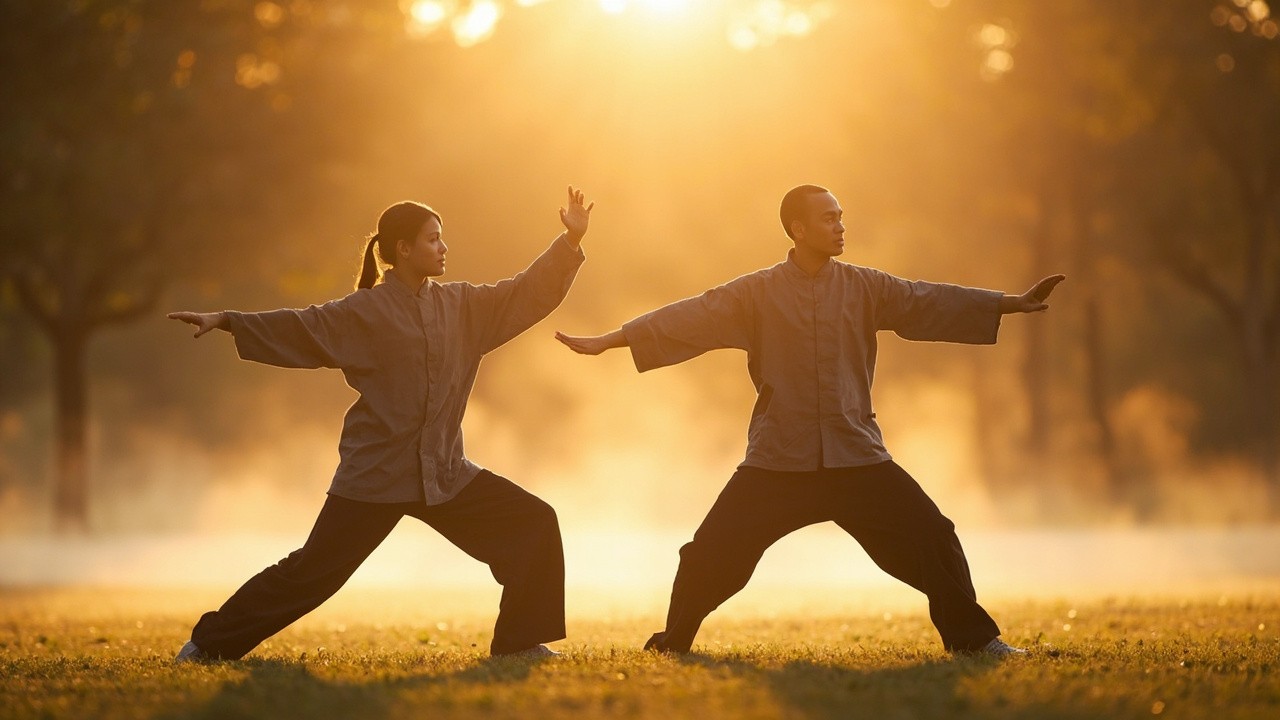
Someone told you to try tai chi. Someone else said qigong. Now you are standing at the doorway of a class or a video, frozen, trying to pick the right one before you have moved a single muscle.
Here is the honest answer to tai chi vs qigong: they are two branches of the same Chinese internal-movement family, they share the same slow, relaxed, breath-led principles, and their benefits overlap heavily. The difference is real but small for a beginner, which means you cannot choose wrong. You are free to switch or do both.
What is the difference between tai chi and qigong?
Qigong is the broader, gentler family, usually built from short, repetitive sets you can do standing or seated. Tai chi is a specific flowing form with more choreography to learn, grown from a martial art and often called a moving qigong.
Think of qigong as the wider category and tai chi as one beautiful, flowing member of it. A common qigong health set like Ba Duan Jin has eight simple movements you repeat, so most people can follow along in one sitting. Tai chi asks you to learn a sequence, a “form,” that strings movements together, which takes a little longer to memorise.
That is the whole practical difference. Both are slow. Both are led by the breath. Both ask your mind and body to move as one thing rather than two.
Why you cannot pick the wrong one
The reason this decision dissolves is that both practices do the same thing to your body. When you move slowly and breathe long and low, your nervous system reads it as a safety signal and shifts out of its alert, braced state.
This is your autonomic nervous system, the part that runs your heart rate, your breathing, and your muscle tension without you asking. Slow movement paired with a steady exhale nudges it toward the parasympathetic “rest and recover” mode, which is where balance, calm, and easy mobility live.
A large review by Jahnke and colleagues looked at qigong and tai chi together, not as rivals, and found strongly similar outcomes across both: better balance, lower blood pressure, improved bone health, and reduced stress and anxiety. You can read the comprehensive review of health benefits of qigong and tai chi on PubMed. The researchers treated them as close cousins for good reason. For your body on day one, the two are far more alike than different.
What centuries of practice already understood
That stuck, braced feeling you carry has an old name too. Practitioners called it qi stagnation, and the entire point of these gentle movements was to get things flowing again, breath and body together.
In my years of teaching, I have watched people agonise over the choice and then relax the moment they actually move, because the first slow arm-raise feels the same whether you call it tai chi or qigong. When someone comes in convinced they must commit to one tradition forever, I show them a single shared movement and the worry usually melts. The old teachers never treated these as competing brands. They were tools from one shared toolbox, and you were meant to pick up whichever was in reach. If you want the simpler on-ramp, this beginner qigong routine shows how little you need to start.
Try the movement both traditions share
You do not have to decide anything to feel this. Here is one slow movement that lives in both tai chi and qigong, so you can experience the overlap in under a minute.
- Stand with your feet about shoulder-width apart, knees soft, arms hanging loose at your sides.
- Let your breath settle at the bridge of your nose. Natural rate, do not force it.
- On a slow in-breath, float both arms up in front of you, palms down, rising to about shoulder height. Let the breath lift the arms, not effort.
- On a slow out-breath, lower your arms back down the same path, soft and unhurried.
- Repeat six to eight times. Notice the pause at the top and the ease on the way down.
That rising and falling on the breath is the shared heart of both practices. If it felt calming, you have already done the thing the whole decision was guarding. For more on why slow movement settles a braced body, see why your body holds onto stress.
Where to go from here
So pick by what is in front of you. If a tai chi class meets near you and the flowing form appeals, go. If you would rather start with something short and repeatable at home, a qigong set is the quickest on-ramp, and you can always try the other later.
Whichever you choose, the breath is the shared engine of both, the rising and falling that both forms are built on.
Get the free breathing guide →
The three breaths that settle a busy mind fast, printable and made to pair with the free timer as you start either practice.
The simplest place to begin is the Ba Duan Jin Eight Brocades guide, an illustrated PDF with a wall chart and follow-along audio, so you can learn a complete qigong set in your own front room. A dedicated tai chi guide for balance is ready for when you want to add the flowing form, with a printable chart and gentle standing or seated movements. And if the chair is your starting point rather than the floor or standing, the Gentle Chair Yoga for Seniors guide is six slow seated yoga poses with a follow-along audio. And whichever you choose, Open QiGuide to keep your practice gentle and consistent. You cannot choose wrong. You can only start.