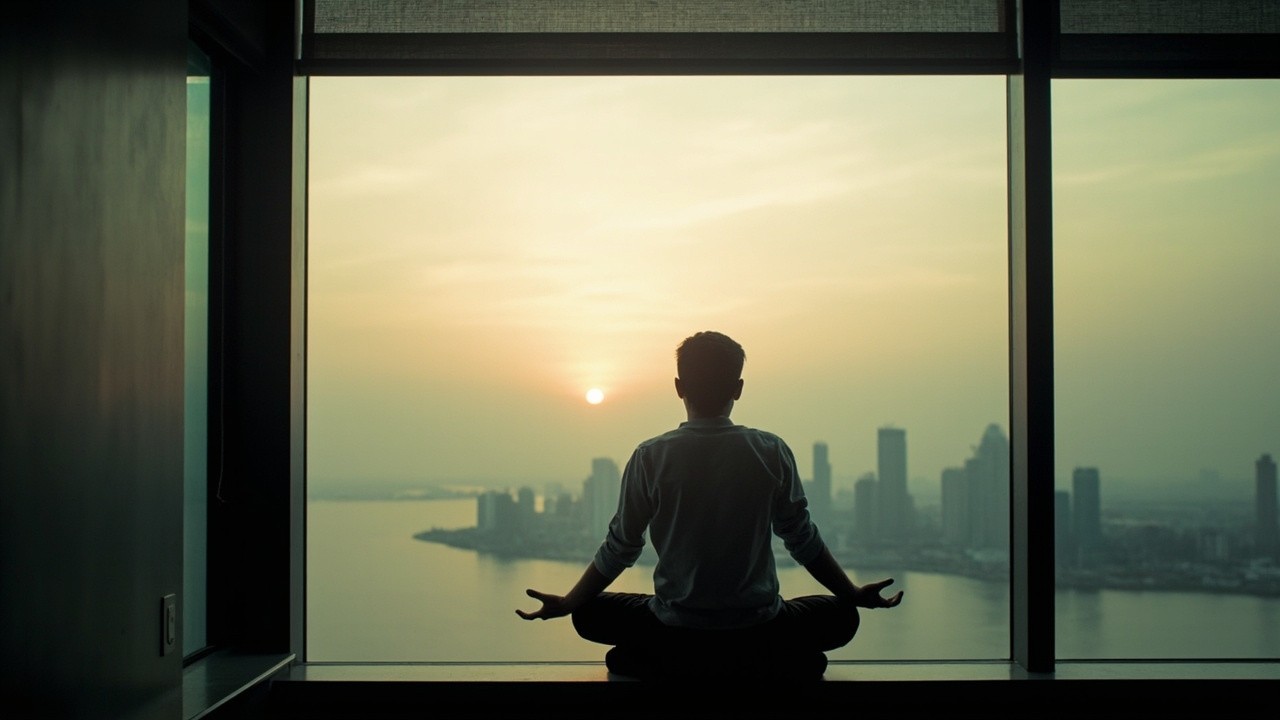
You are staring at a decision you should have made hours ago, turning it over for the hundredth time, and it is no clearer than when you started. Or you are lying awake trying to force yourself to sleep, or rehearsing a hard conversation until your jaw aches. The harder you push, the worse it gets.
Here is how to practice wu wei in that exact moment: stop adding effort and take one thing away instead. Wu wei is not doing nothing, it is not forcing, and the way you practise it is by noticing the grip and loosening it, usually starting with your body before your mind. You do less on purpose, and let the right move surface once you quit white-knuckling the outcome.
What does wu wei actually look like in practice?
In practice, wu wei is catching the moment you start to force something and choosing less effort instead of more. It is not a philosophy you admire from a distance. It is a small, physical redirection you make dozens of times a day, the split second you feel yourself grinding and decide not to.
If you want the full meaning of the term and where it comes from, this piece on what wu wei means covers the definition properly. This article is the other half: not what it is, but how you live it when you are the kind of person who white-knuckles everything.
The overthinker’s version of wu wei is simple to say and hard to do. When you catch yourself forcing, you stop forcing. The skill is in noticing early and in trusting that easing off is not the same as giving up.
Why does trying harder make overthinking worse?
Trying harder makes overthinking worse because the forcing is the problem, not the solution. When you grind at a worry, you are recruiting the same mental control system over and over, and in people who ruminate that system gets over-used rather than working better. More effort feeds the loop instead of closing it.
You have felt this. The decision you tried to force never got clearer, it just got heavier. Rumination, that repetitive churning over the same thoughts, is linked by psychiatrists to worsening anxiety and depression precisely because the mind keeps chewing without resolving anything. The effort is not neutral, it costs you.
Brain research backs this up. A 2024 study found that rumination involves an over-recruitment of the brain’s cognitive control network, meaning the mind is straining harder, not smarter. That is the physiological version of white-knuckling. Wu wei works because it does the one thing the overthinking system cannot do for itself: it takes the strain off. If you know this loop well, here is more on why you can’t turn your brain off.
What ancient practitioners understood about forcing
The paradox that pushing harder makes things worse is not a modern discovery. Practitioners named it centuries ago and built a whole approach around it: the most skilful action often comes from not forcing, from moving with the situation instead of against it. They understood that a mind clenched around a problem is the least likely to solve it.
In my years of teaching this, the overthinkers are always the hardest sell and the biggest relief once it lands. They come in convinced that if they just think harder they will crack it, and I watch them exhaust themselves on the same three problems. When I get them to drop the grinding and settle the body first, the decision they could not force usually arrives on its own within a day.
That is the lived version of wu wei. You are not being lazy, you are getting out of your own way, and the answer shows up in the space you finally left for it.
How to practise wu wei when your mind is forcing
The body is the way in, because you cannot argue a clenched mind into loosening but you can breathe it there. Do this the moment you notice you are forcing something.
- Notice the forcing. Catch the physical signs first: the tight chest, the held breath, the jaw. That noticing is the practice starting.
- Take one slow exhale, longer than the inhale, and let your shoulders drop. This is the switch that tells your body to stop straining.
- Ask what forcing you can drop, not what effort you can add. Sleep on the decision. Send the shorter message. Do the simple next thing, not the whole plan.
- Let the situation move. Instead of holding the outcome in a fist, loosen your grip and see what the moment actually asks for. Act from that, not from the grinding.
If the forcing is a bodily habit you carry all day, a gentle movement practice resets it faster than thinking does. This beginner qigong routine gives you a simple way in.
Two everyday examples of wu wei
Take a work decision you cannot settle. The forcing version is you grinding it at 11pm, listing pros and cons you have already listed twice. The wu wei version is you naming that you are forcing, closing the laptop, and letting it sit overnight. Nine times out of ten the choice is obvious by morning, because you stopped strangling it.
Take a night you cannot sleep. Forcing sleep is the surest way to stay awake, because trying is the opposite of the letting-go sleep requires. The wu wei version is to stop trying to sleep and simply lengthen your exhale, letting the body settle without demanding the outcome. You do less, and sleep arrives in the gap.
Notice what both examples share. You did not do nothing. You removed the forcing, and let the right thing happen in the space that opened up.
Wu wei is not doing nothing
The close is the correction of the biggest misconception. Wu wei is not passivity, checking out, or letting your life drift. You still make the decision, have the hard conversation, do the work. You just stop white-knuckling the result.
Practised daily, this becomes less a technique and more a default. You start to feel the forcing early, in the body, and ease off before it snowballs. Keep it small and keep it consistent, on the easy days as much as the hard ones. Try dropping one forced thing today.
Four Taoist non-forcing practices for the days you catch yourself white-knuckling, a calm seven-page read.
Open QiGuide when you want to build the habit properly.