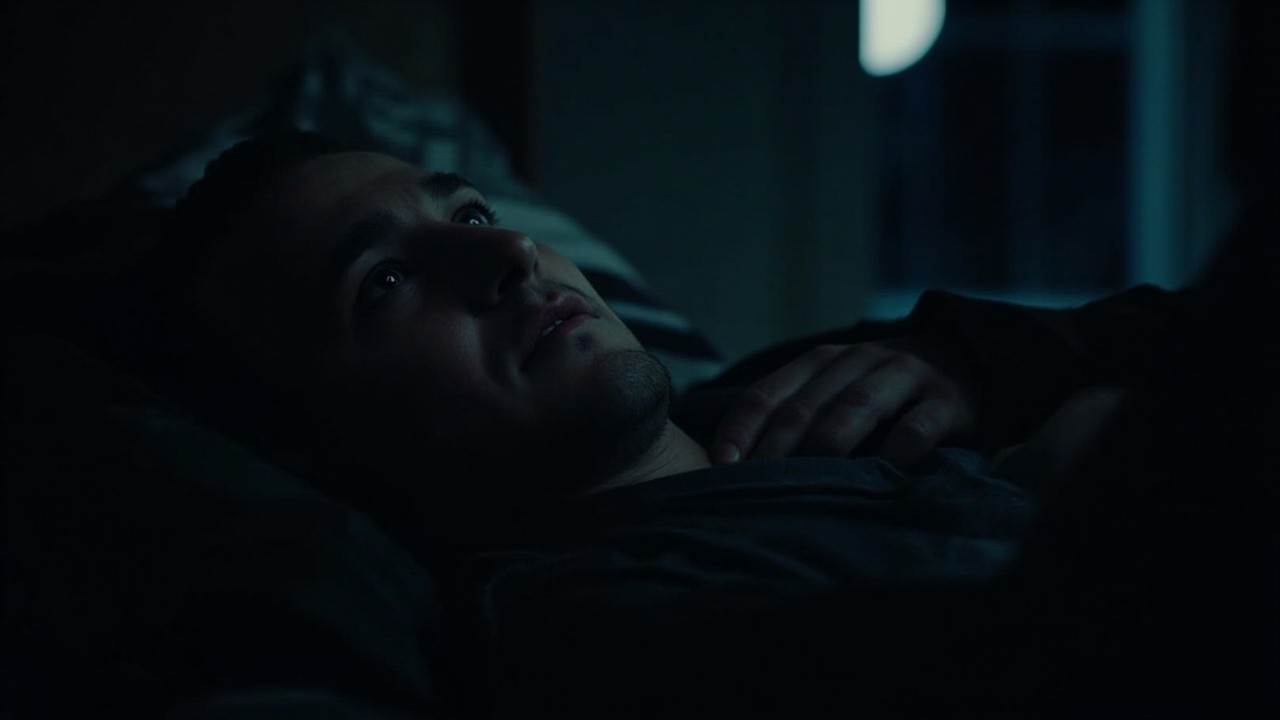
You know the moment. The lights are off, the pillow is cool, your body is tired. But your mind has other plans. It pulls up that conversation from the afternoon meeting. Replays the email you should have written differently. Builds tomorrow’s to-do list in vivid detail. And the longer you lie there, the louder it gets.
If you can’t stop thinking about work at night, you’re not broken. Your nervous system is still running the workday long after your body left the desk.
Why does your mind replay work at bedtime?
The problem isn’t your thoughts. It’s your nervous system.
When work stress stays active in your body, it creates a loop that researchers call perseverative cognition. Your mind keeps cycling through the same work-related content because your body hasn’t finished processing the stress. A meta-analysis in the Journal of Psychosomatic Research found perseverative cognition is one of the key mechanisms linking perceived stress to sleep disturbance. Work stress doesn’t just make you tired. It keeps your body wired in a way that prevents sleep from arriving.
This is why the replay feels so stuck. It isn’t a thinking problem. It’s a body problem.
You can’t reason your way out of it because the loop isn’t happening at the thought level. It’s happening in your chest, your jaw, the tight band behind your ribs. Your body is holding the workday like a physical object, and until you address that held tension, the mind keeps circling.
This is the same pattern behind why you can’t turn your brain off at any hour. But at night, with nowhere else to direct your attention, it becomes unbearable.
How do you switch off from work at night?
You stop trying to think your way out and start working with your body.
The practical shift is this: instead of analysing the to-do list running through your head, you turn your attention to the physical sensation underneath it.
Try this when the replay starts:
- Pause. Notice where in your body you feel the work. The tight chest. The buzzing behind your eyes. The clenched jaw. Don’t judge it. Just locate it.
- Bring your attention to your breath. Feel it at the bridge of your nose, the cool air in, the warm air out.
- Let your exhale be slightly longer than your inhale. Not forced. Just a gentle extension. This signals safety to your nervous system.
- Stay curious. “How do I feel, knowing the workday is still running in me?” Notice the sensation soften, shift, or release.
You’re not solving the work problem. You’re melting the charge your body is carrying around it. Once the physical intensity drops, the mental replay loses its grip. Sleep becomes possible again.
Get the free guided breathing practice →
A simple body-based breathing practice you can do in bed. Free, sent straight to your inbox.
Why does the body hold work stress in the first place?
Because your nervous system doesn’t distinguish between a real threat and a demanding workday. Both activate the same survival circuit. If your body has learned to hold stress as its baseline, every workday adds another layer. By the time you lie down, your body is carrying the full weight of weeks and months of unprocessed activation.
The breath practice above works because it addresses the body directly. Longer exhales activate the parasympathetic nervous system. The physical charge begins to release. The mind, no longer needed as a stress outlet, quietens on its own.
What should you do when work thoughts won’t stop?
Don’t fight them. Don’t try to empty your mind. Both strategies create more tension, and tension is exactly what’s keeping you awake.
Instead:
- Locate the feeling. Where does the work show up in your body right now?
- Breathe into it. Slow breath. Longer exhale. Let the sensation move.
- Let the thoughts be there without engaging. They’re noise from an activated nervous system, not problems you need to solve at midnight.
When you address the body first, the mind follows. This is the core of any effective wind-down practice.
When is the best time to switch off?
The window matters. The first hour after you get into bed is when the day’s activation is most present. This is when the breath practice has the most impact. If you wait until you’ve been lying awake for an hour, the stress cycle has already deepened.
Make it part of your nightly wind-down. Give yourself twenty minutes before sleep. Spend the first few minutes on the breath practice. Let the rest be whatever feels calming. Over time, your nervous system learns that bedtime means safety, not stress review.