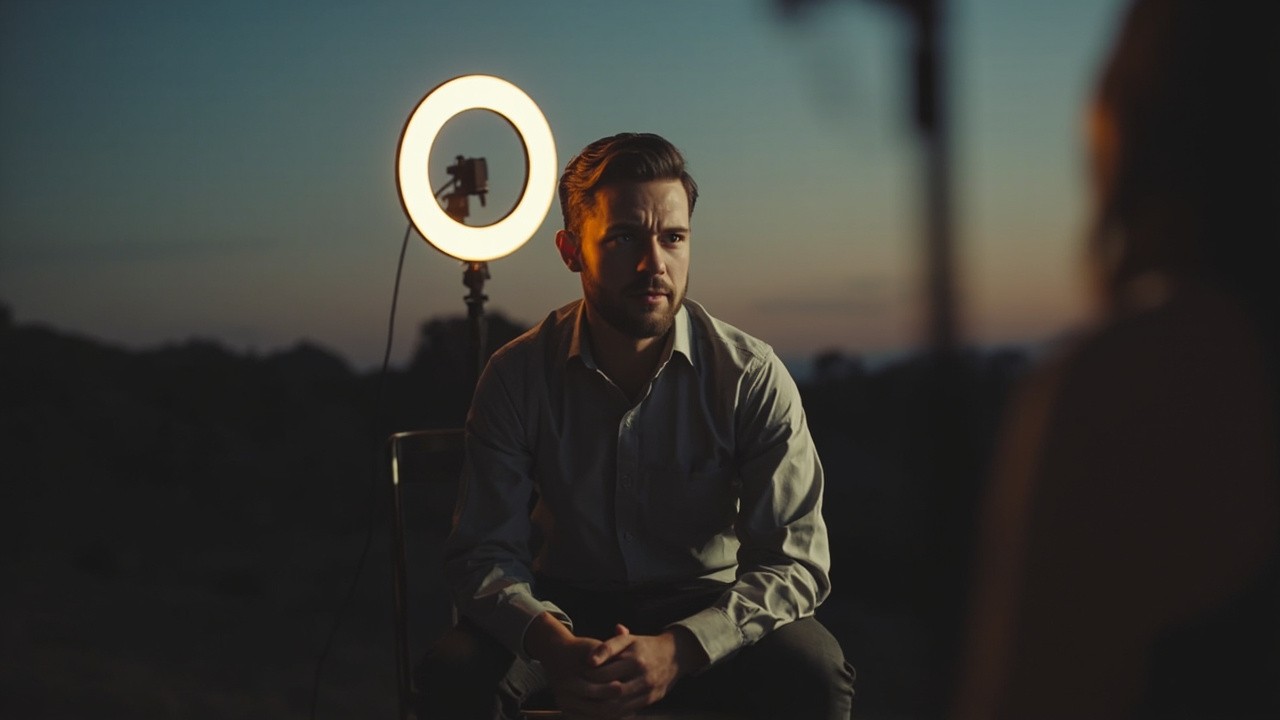
The red recording light comes on and something in your chest slams shut. A second ago you were talking like a normal person. Now your throat is tight, your face feels stiff, and the words you rehearsed have gone somewhere you cannot reach. The webinar is live, the little camera dot is staring, and you have gone rigid.
If you freeze up on camera presenting, here is what is actually happening: the lens is reading to your nervous system as a watching crowd, and your attention has snapped inward onto how you look and sound. That inward clamp, not a lack of preparation, is what locks you up. The fix is not more confidence. It is getting your attention out of your own head and back into your body.
Why does the camera make me freeze when I talk?
The camera makes you freeze because it turns you into your own audience. The moment you can see yourself, or even know you are being recorded, part of your attention peels off the message and starts monitoring you: your expression, your voice, whether you look as nervous as you feel.
That self-watching is the trap. In a normal chat you look at the other person, so your attention flows outward and your body stays loose. On camera it loops back on you, and that loop is what tightens the throat and freezes the face. You are not bad at presenting. You are stuck watching yourself present.
Why am I fine in conversation but stiff and frozen on camera?
You are fine in conversation because your attention has somewhere to go: the other person. On camera, especially on a video call where your own face is on screen, attention gets pinned on the self instead. Researchers call this self-focused attention, and it reliably makes performance worse under pressure.
A study on self-focused attention and performance failure found that psychological stress increases self-focus, and that more self-focus predicts more breakdown in the moment. The video call adds its own twist: you are looking at a tiny mirror of yourself the whole time, which feeds the loop. The fix is to stop feeding it.
What is happening in your body when you freeze
Freezing is not weakness, it is a brake. Your nervous system has three broad gears under threat: fight, flight, and freeze. When fight and flight both feel impossible, when you cannot leave the webinar and you cannot fight the lens, the body defaults to the freeze gear. Muscles brace, breath goes shallow, the voice locks.
This is the same protective reflex that makes animals go still under threat, sometimes called tonic immobility. Your body cannot tell the difference between a predator and a recording light that means “everyone is watching now.” It reads exposure and slams the brake.
Harvard researchers describe choking under pressure as the result of overthinking a skill you already have, where conscious self-monitoring jams up an action that normally runs smoothly. Talking is a skill you have. The freeze comes from suddenly watching yourself do it. This is the same survival wiring that keeps people stuck on alert long after the threat is gone, which this piece on the nervous system in survival mode explains in more depth.
What practitioners noticed about the body’s brake
That locked, guarding stiffness has an older name too. Traditional practitioners saw it as stuck qi, energy that has stopped moving because the body has braced against something. Their answer was never to force it loose. It was to soften so it could flow again, which is the opposite of what most camera advice tells you.
In my years of teaching this, I have watched people try to muscle through the freeze by sitting up straighter and pushing harder, and it always makes the clamp worse. When I work with someone who locks up the second the light comes on, the shift happens the moment they stop fighting the stiffness and meet it gently instead. The body unguards when it feels met, not when it is overpowered. Your body holds tension in patterns you may not notice, and here is why it does that.
A body-first practice to unlock before you speak
This takes about sixty seconds and you can do it with the camera already on. The goal is to drop attention out of the self-watching head and back into the body, so presence returns instead of performance-mode rigidity.
- Bring your breath to the bridge of your nose. Feel the air at the inside edge of your nostrils, the cool of it. Natural rate, do not force it slow.
- Notice the clamp. The tight throat, the locked chest, the stiff face. Name where it sits in the body, not the story about it.
- Keep the feeling at one percent. Do not sink into the panic. Let the breath hold the rest of your attention while you just acknowledge the clamp is there.
- Soften, do not brace. Let your jaw unclench a little, let your shoulders drop, let the stiffness ease rather than stiffening to look calm.
- Ride the wave. If the freeze does not lift at once, soften your attention further until it starts to melt. Let it change on its own. Then look at the lens like it is a person, and begin.
If you can, hide your own self-view on the call. Less mirror, less self-watching, less freeze.
Get the free breathing guide →
The three exhale-led breaths you can run in the seconds before the light comes on, printable and made to pair with the free timer.
Bringing presence back when the light comes on
Freezing on camera is a wiring problem, not a confidence problem, and you cannot think your way out of a body that has hit the brake. What works is meeting the clamp gently and moving your attention out of your own head, in real time, right as the light comes on.
QiGuide walks you through this body-first practice step by step, so you can run it before a webinar or a recording and feel the stiffness ease instead of fighting it. If the camera has been making you freeze, this is the practice to have in your pocket. Open QiGuide and try it before your next live presentation.
If you want the breathing side of this in a form you can rehearse ahead of time, the Breathing Exercises for Anxiety and Stress printable lays out simple exhale-led techniques to settle the body before the light comes on. A one-time download, nothing shipped.