You learned one movement from a video on a Tuesday. A week later you picked up a different one from another teacher who did it slightly differently. Then a third turned up in some morning routine you saved and never opened again. None of it ever became a practice. Every session started with the same quiet stall: okay, what do I actually do today?
That stall is why most people quit qigong, and Ba Duan Jin removes it. Ba Duan Jin, the eight brocades, is a fixed, centuries-old qigong routine of eight slow movements done in the same order every single time. You never decide what to do. You start at movement one and finish at movement eight, which is exactly why beginners who could not stick with loose exercises can stick with this.
Why can’t I keep a qigong practice going?
Because every loose session asks you to make a decision before you have even started, and decisions are the thing you have least of in the morning. You collected movements like a playlist with no order. One day it was a shoulder thing, the next a breathing thing, and there was never a clear beginning or end. So the practice stayed a pile of parts instead of a routine.
You have probably tried to fix this with willpower, telling yourself to just be more consistent. That rarely holds, because the problem was never discipline, it was the missing structure. A session with no fixed shape reads to your brain as optional planning work, and that is the first thing dropped on a busy morning. A routine that survives has to make the first move for you.
What is decision fatigue, and why does a fixed sequence beat it?
Decision fatigue is the tendency for your choices to get worse, and less likely to happen at all, as decisions pile up across a day. Every choice draws on the same limited pool of self-control, so by the time you reach an optional thing like exercise the tank is low and skipping wins. Psychologists have studied this link between willpower and self-control at length, including the American Psychological Association.
A fixed sequence sidesteps the whole problem. When the movements and their order never change, there is no choice left to make, so there is nothing to deplete. Your body learns the chain, movement one leads to movement two, and the routine starts running almost on its own. This is also why a regular gentle practice helps the body let go of held tension, which builds up in ways most people never notice. The research on the form itself is encouraging too: a controlled study of Ba Duan Jin found measurable improvements in quality of life and reductions in stress markers, summarised in this PubMed Central paper.
The eight movements, in order
Here is the classical sequence so you know the shape of the whole thing. These are the names and the order, not full step-by-step instruction. The point right now is the spine of the routine, what comes after what.
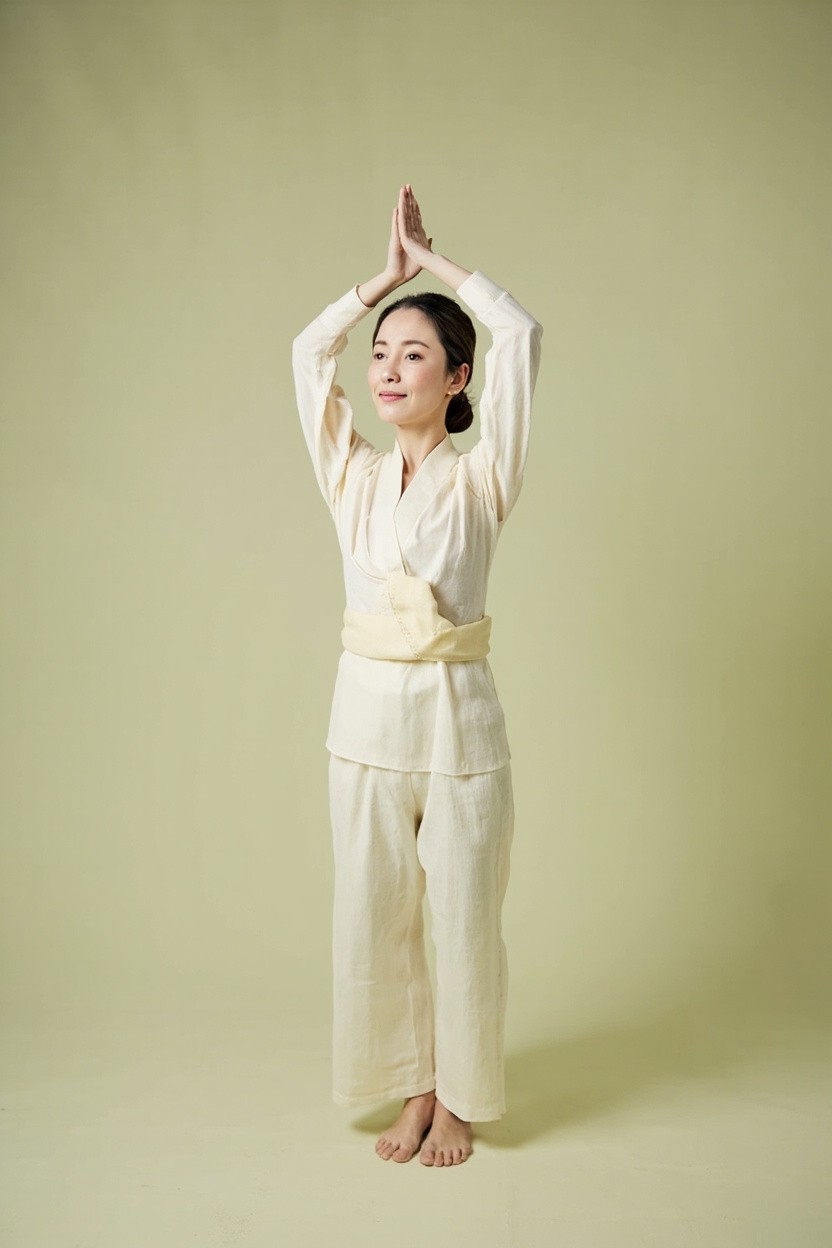
- Holding Up the Sky. Arms sweep overhead, fingers laced; a full-body stretch that opens the breath and resets posture.
- Drawing the Bow. Wide low stance, arms pull apart as if firing an arrow; gentle strength through shoulders, arms and chest.
- Separating Heaven and Earth. One palm presses up while the other presses down; a light stretch through the waist.
- Wise Owl Looks Back. Head and gaze turn to look behind; releases the neck and shoulders.
- Sway the Head and Swing the Tail. A slow lean and turn from a low stance; cools a wired, overheated feeling.
- Two Hands Hold the Feet. A forward fold reaching down the legs; lengthens the spine and the whole back line.
- Clench the Fists and Gaze Steadily. A controlled punch from a low stance with a focused stare; builds heat and resolve.
- Bouncing on the Toes. Rise onto the balls of the feet and drop the heels; wakes the legs and settles the routine to a close.
Eight movements, same order, every time. That is the entire decision you no longer have to make.
A first step you can take this morning
I tell every frustrated beginner the same thing: you do not need the full eight to begin. The fastest way to turn this into a routine is to anchor the very first movement so your body has a fixed starting point, then let the breath lead.
- Stand with your feet about shoulder-width apart, knees soft, and let your arms hang. Breathe at the bridge of the nose, the inside sensation of the air, at a natural rate. Do not force it.
- On a slow inhale, sweep both arms out and up until your hands meet overhead, fingers loosely laced, palms turning toward the sky. Let the breath lead the movement, not the other way round.
- At the top, allow a light lengthening through your whole front, from the floor of your belly up through your fingertips. Keep it gentle. This is a stretch you ease into, not push.
- On a slow exhale, unlace your hands and float your arms back down the sides. Soften everywhere as they descend.
- Repeat this same movement slowly six to eight times, every morning, in the same spot. Once it feels automatic, add movement two, then the next, until the full set runs without thought.
Lightness over effort, consistency over duration. A few minutes done daily will reshape your mornings more than a long session done once.
Get the free breathing guide →
The three exhale-led breaths that steady the mind, the foundation every brocade settles into, printable and made to pair with the free timer.
Where to go from here
Start with movement one tomorrow, same place, same time, and let the routine build itself from there. If you want the full eight-movement set with proper form, the Ba Duan Jin Eight Brocades guide lays it all out: a fourteen-page illustrated PDF, a one-page wall chart, and a follow-along audio you can practise to, for nine dollars as an instant digital download with nothing shipped. If you are completely new to the practice, our beginner qigong morning routine is the gentle on-ramp before you commit to the full sequence. And to keep the calm going through the day, Open QiGuide for short guided practices whenever you need to settle.