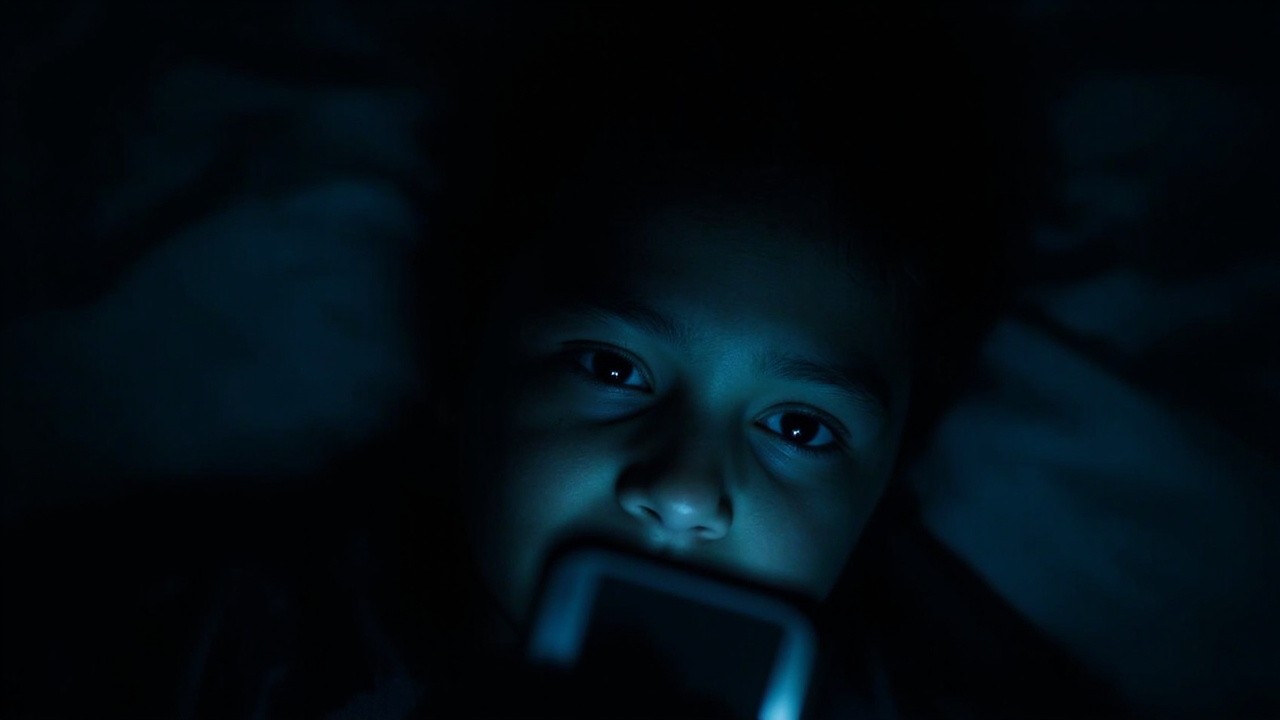
It’s 1:17am and you’re still here. Face lit by the screen, eyes gritty, thumb gliding upward while the voice in your head says the same thing it said an hour ago: put it down, you’re exhausted. You don’t put it down. You keep going, and you hate that you keep going, and the worst part is that you’re not even enjoying any of it.
Here’s what’s actually happening: you can’t stop doomscrolling at night because the scrolling isn’t just the problem, it’s your nervous system’s attempt to handle a feeling it doesn’t want to sit with. The exhaustion in your body and the wired alertness behind your eyes are both real, and the phone is the place you run to escape the wired feeling. That’s why “just put the phone down” never works. It treats the symptom while the running feeling stays right there, waiting for you.
The answer isn’t another screen-time app or a stricter bedtime. It’s a one-minute reset that meets the body where the feeling already lives: notice the wired feeling, keep it small, let the grip in your hand melt instead of fighting the habit. This is not about the phone at all. It’s about the sensation underneath it.
Why Can’t I Stop Scrolling at Night Even Though I’m Tired?
You can’t stop because the doomscroll is driving a state shift, not reflecting one. At night your nervous system should be settling toward rest, but a feed of bad news keeps your brain in a wakeful, threat-scanning pattern. Psychologists call this the negativity bias: your brain pays more attention to threatening information than neutral or positive information because that wiring kept your ancestors alive. Every alarming headline feels urgent, so the loop keeps pulling the next swipe.
The problem turns vicious at night. Screen light in the evening disrupts your body clock and throws the circadian rhythm that governs your sleep-wake cycle out of whack, and blue light specifically suppresses the signals that prepare you for sleep. So you lie there genuinely exhausted, with a brain that’s been trained to treat everything as urgent and a body clock that’s been told it’s still daytime. Of course you can’t just “choose” to stop. The engine is running.
What Does the Feeling Underneath the Scrolling Feel Like?
If you pause mid-scroll right now and look past the screen, you’ll find it: a forward-leaning tension somewhere between your chest and your throat, or a restless pressure in the hand, or a quiet buzz behind the eyes. It can land anywhere, and it can feel different on different nights. That feeling is the real driver. The moment you try to put the phone down, the feeling gets louder, so you pick it back up to drown it out.
Most advice misses this. Sleep-hygiene lists tell you to stop using screens an hour before bed, but never mention what to do with the restless feeling that appears the second you do. This is where your body has a head start on your willpower, and willpower has been losing this fight for months. When you work with the sensation directly instead of arguing with the behavior, the grip in your hand softens on its own, because the reason for gripping is gone.
Here’s the practice I use with this exact pattern, the one I walk people through in my classes. Set the phone down first — nightstand, mattress edge, wherever it can sit without you reaching for it. Then:
-
Rest your attention at the bridge of your nose, on the inside sensation of each breath — the cool air coming in, the warm air going out. Natural rate. Don’t force it.
-
Bring the doomscroll to mind lightly. Not the headlines, the body: “How do I feel knowing this is here?” Find that sensation. It usually lands as a buzz, a tension, or a pressure — sometimes in the chest, sometimes in the hand, sometimes behind the eyes. The exact form doesn’t matter. What matters is that you find it.
-
Keep the sensation at 1%. Let the breath hold the other 99%. You are not fighting the feeling or sinking into it, just letting it be small.
-
Lighter, not harder. If it won’t shift, soften your attention until it melts. Let it change. Ride the wave instead of trying to push it away.
That’s the whole reset. No screens moved to the kitchen, no guilt spiral, no counting hours of sleep. Just one minute of showing the body that the feeling is survivable, and it eases. When it has eased, notice what your hand does when it isn’t gripping anything.
Get the free breathing guide →
Six simple breath practices for the exact moments your nervous system won’t settle, including bedtime. Free, sent straight to your inbox.
Why Does My Body Keep Scanning for Bad News?
Because scanning is what an over-alert nervous system does best. Chronic stress keeps your nervous system in a survival-ready state, and in that state threat-scanning isn’t a choice, it’s the default. The doomscroll is the perfect partner for it: an endless supply of things to scan, each one feeding the alertness that keeps you awake. If your body has been running like this for a while, the pattern deepens, as I’ve written about in why your nervous system won’t switch off.
The habit feeds on itself: the more you scroll, the more alert you get; the more alert you get, the more you need the scroll to handle the feeling. That’s why cold-turkey rules fail so often. You’re interrupting the coping mechanism without touching the state underneath, which is the same reason your mind races at night when you finally do try to sleep. The stillness doesn’t feel safe yet.
What Traditional Practice Knew About This Restlessness
That buzzing, can’t-settle feeling has a name in traditional practice too, and practitioners worked with it for centuries before any of us had a phone. The Taoist tradition called the unsettled state “shen” (spirit) that had lost its anchor: spirit floating, attention scattered outward instead of rooted at home. The remedy was never to scold yourself for the distraction. It was to return attention to the body and let the breath do the settling.
In my years of practice I’ve noticed the same thing in everyone who comes in with this exact pattern: the moment they stop chasing the restless feeling, it starts to dissolve on its own. When people try to force themselves to be calm, the tension resists. When I have them drop the fight and rest at the breath, the wire in the chest loosens by itself. Your body already knows how to settle. It’s just waiting for you to stop overriding it, which is also what QiGuide’s practice companion is built for: Open QiGuide to get a guided version of this reset the next time the 1am pull starts.
One minute tonight. Phone where it is, attention at the breath, feeling at 1%. Tonight you find out what your hand does when nothing is forcing it to hold on.